Cyprus Field Trip
Day 1 - 19 March 2015
Day One – The High Troodos Massive
The drive to the central Troodos Massive from Limassol necessarily entailed driving over the upper layers of the island rock sequence which had been exposed much later than the central massive.
These layers would be explored later in the field trip but it was interesting to note as we drove towards the Troodos Massive the complete sequence in rock types ranging through: younger Pakhna Chalks; older Pelagic Lefkara Chalks; Pillow Lavas; Intrusive Dykes; Ultramafic Plutonics and Mantle Peridotites. Also visible were the younger Marls and Clays from the much later atmospheric erosion of the central massive.
First Location
This was a viewpoint near the village of Doros on the B8 which gave a good overview of the distant Troodos Massive and its surrounding sedimentary cover. From this viewpoint we were able to get a general understanding of the disposition of the geological units and structures.

Troodos Ophiolite in the distance; Chalks in the foreground

Paul in full flow
Paul explained that Ian Gass, who was the first professor of Earth sciences at the Open University, was the first person to recognise Troodos as an Ophiolite. Most of the current Troodos data is his work. He found that the distinct igneous rock sequence of an Ophiolite was consistent across the whole of the Troodos.
The overall structure of an Ophiolite bottom to top is:
· Mantle Rocks (Darker & greener Mafic Peridotites & Dunnites)
· Layered Plutonic Magmas (Gabbros)
· Sheeted Dykes (Coherent rock shapes)
· Pillow Lavas (erode quickly to soils)
This structure rose, domed and eroded to form annular rings of pillow lavas, sheeted dykes, plutonics with mantle at the top. The Cyprus Ophiolite is not circular but squashed along an East-West axis due to the continuing collision of the Eurasian and African plates. There is also a North-South asymmetry (dip to the South) caused by the Eurasian plate moving faster than the African plate.
Second Location (Victoria Bridge)
The exposure here was on the old road and showed a distinct junction between two different rock types, on the left green and on the right yellow.

The MOHO (Left – Mantle (Hartzburgite); Lower Oceanic Crust – Right)
Paul explained that the green rock was Mantle and the yellow rock was lower oceanic crust and in fact we were looking at the MOHO! Note that this is the lithographic MOHO and is the phase boundary between the mantle/crust partial melts. The Seismic MOHO is in a slightly different place where the velocity of sound changes due to structural rather that chemical differences in the mantle/crust rocks.
The chemistry of the lithographic MOHO can be explained as follows:
1. The original ultramafic mantle rock is a mixture of Peridotites and Pyroxenites i.e. Olivine + Clino Pyroxene + Ortho Pyroxene (different crystal structure to Clino Pyroxene).
2. At the MOHO partial melting occurs and Clino Pyroxene preferentially accumulates in the melt
3. Hence Clino Pyroxene concentrates in the oceanic crust and is depleted in the mantle
4. This depleted mantle rock is called Hartzburgite.
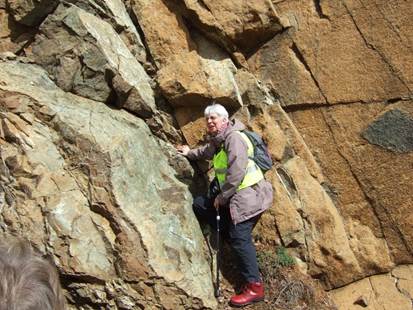
A Hand on the MOHO!
We also observed some Serpentinisation caused by seawater reacting with the mantle and crust Peridotites under high pressure and temperature. This was greater in the Hartzburgite.

Serpentinisation of Hartzburgite
Third Location
This site was a little further up the road. The exposure at first sight looked like sedimentary rocks with dips but Paul explained that it was in fact layered Gabbro (coarse grained) and layered Dunite (fine grained). This represents the next layer of the Oceanic Crust above the previous MOHO exposure at the second location.
The layering process is caused by local cooling of rising magma in chambers. The crystals so formed sink back to form layering. There is also a gradation of crystal size because of differential cooling. It is this structural change that causes the sound velocity to change from that in the mantle rocks. This then defines the seismic MOHO.

Layered Gabbro & Dunite in Oceanic Crust at the Seismic MOHO
Lunch

Lunch at Troodos Village

Snow at Troodos Village
Fourth Location
This exposure was just down the Amiandos Road from Troodos Village. We observed sections of mantle Hartzburgite which was very fractured. This was an example of ‘Spreading Ridge Architecture’. Here the mantle movement is plastic deformation at lower levels but brittle deformation at higher levels where the temperature is lower. At the spreading ridge itself material is moved sideways and cools and is even more brittle. This then leads to the observed fracturing.
More fracturing occurs as the massive is uplifted. The cracks are generally filled with minerals but not serpentinised as there is no water at the depth (~20km) at which these rocks & cracks were formed. However later surface veneering with serpentinite was also visible.
[Chemically serpentinisation is the hydrolysis of Olivine (Mg+2, Fe+2)2SiO4 [water + pressure + heat] to produce the Serpentine Group (Lizardite, Antigorite & Chrysotile) sometimes with varying small amounts of chromium, manganese, cobalt & nickel. It can produce a variety of attractive greenish colours to rocks and may derive its name from the appearance of snake skin.]
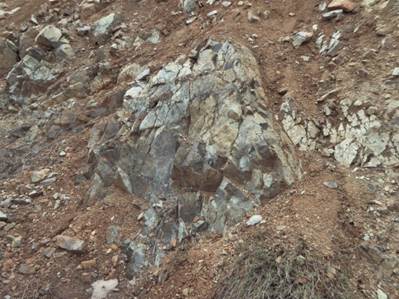
Brittle fractured mantle Hartzburgite at spreading ridge
Fifth Location
This site was just 300 m further down the road from site 4. Here we saw examples of diapirism in mantle rock (mainly Olivine). Here large Diapirs of melt, caused by pressure reduction, rise up by convection in a mainly lamina flow regime. This lamina flow was clearly illustrated by sets of parallel vertical lines of Pyroxene crystals in the yellow mantle rock.

Vertical lines of Pyroxene crystals in mantle rock indicating laminar flow
Sixth Location
This site was further down the Amiandos Road at the Pano Amiandos viewpoint. This viewpoint overlooked the site of an opencast asbestos mine. Mining ceased some time ago at the site is in the process of being restored by terracing and the planting of conifers.
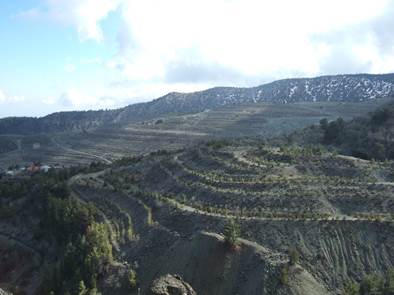
Restoration of Opencast Asbestos Mine viewed from Pan Amiandos
White Asbestos (Chrysotile – Mg3(Si2O5)(OH)4) is the end product of the serpentinisation of mantle peridotite. Hence this sixth site represented the final stage of the day’s journey through the rocks and minerals of the Troodos Massive Ophiolite.